Action

Submissive task app with 48 ideas to try

Create a one-time D/s task in Action → Plans, or choose a prompt from the 48 ideas below. A personal task stays in your space. A shared task starts after your connected partner accepts it.
How to set up your first shared task

  1. Choose one action. Open Action → Plans and write a task with a clear finish. D/s means dominance and submission: the roles you agree on together.
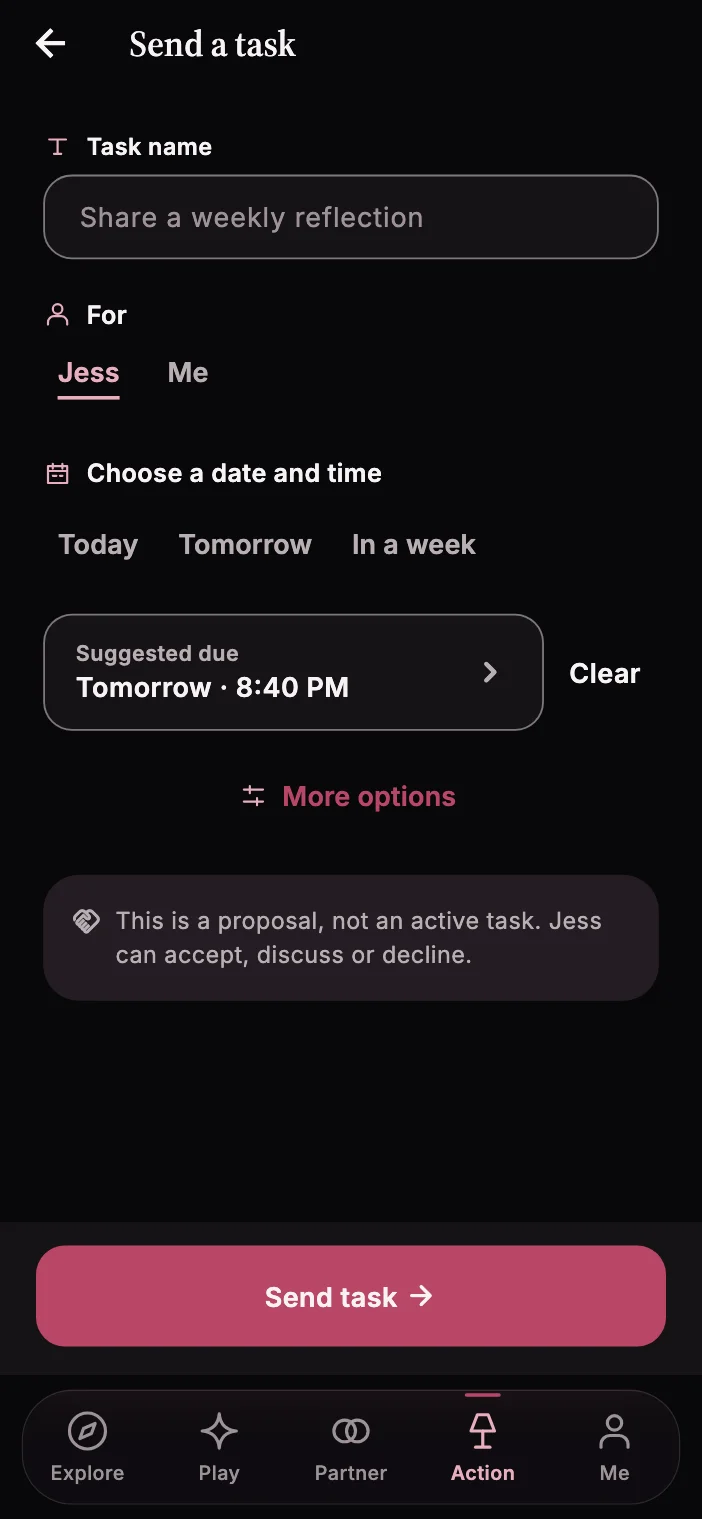
  2. Discuss the proposal. Choose who will do it, any due time, and whether completion needs a note or photo. Your connected partner can accept, ask for changes, or decline.
  3. Complete and review. Follow the completion requirements shown on the task. Some tasks finish when the responsible person marks them done; others require submission and partner review.
Cuffplay task proposal form with task name, recipient, due time, and a reminder that the partner must accept.
Create a shared task proposal. Actual app screen with example data.

A first task you can copy

Title: One thing I appreciated today

  • Action: Write one sentence about something you appreciated.
  • Timing: This evening, when you have a quiet moment.
  • Done means: One sentence; no photo or location is needed.
  • Discuss first: Who will do it, how completion will be recorded, and what to do if tonight no longer works.

Copy the wording into a new Plan and adapt it before sending a shared proposal. This is an example, not an automatically created task.

Give the task a clear finish

Write what to do, who will do it, and what counts as done. A long-distance task could be “send one sentence when you get home”, with no location sharing. For a routine that repeats, use the habit tracker.

Agree on proof and timing before starting

A shared task can use no proof, a text note, or a photo. Agree on what the task asks for before accepting. A shared task with a due time can generate a slip after it becomes overdue. Review what happens in Vault.
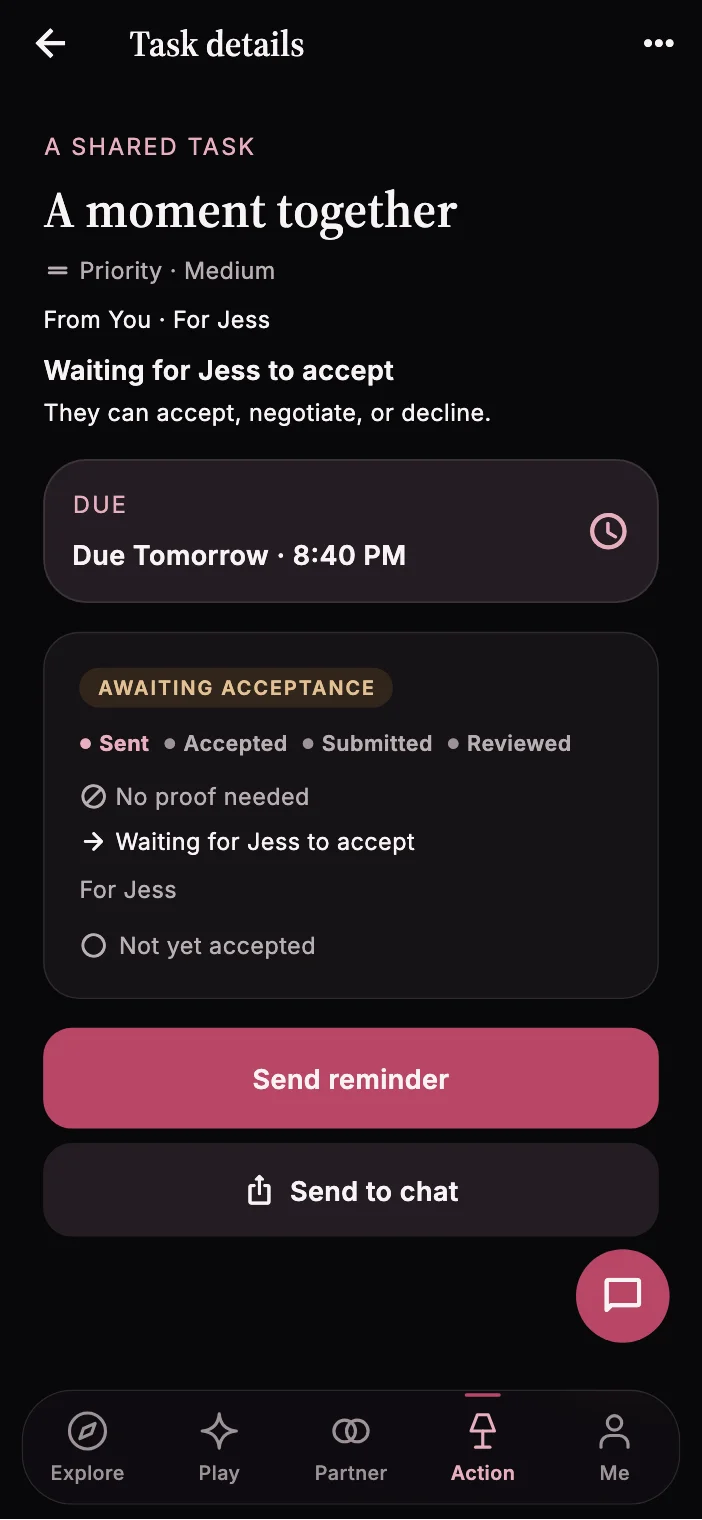
Cuffplay shared task details showing awaiting acceptance, due time, and the sent, accepted, submitted, and reviewed stages.
A sent proposal waits for acceptance. Actual app screen with example data.

Pause when circumstances change

Either partner can use the shared safety light to pause practice. A paused task is not permission to keep going offline. Discuss what to change before continuing. If you need a smaller first step, read our daily submissive task ideas or long-distance D/s task guide.

48 D/s task ideas

Choose one example and copy it into Plans. If it involves your partner, send it as a proposal. They can accept, ask for changes, or decline. If you want to repeat it, make it a ritual.

Soft

Ordinary, short, and easy to skip. These match the tone of the four built-in starters.

Good-morning check-in

Who
The follow sends it. The lead may answer or only read it. Alone, you write it to yourself. This is a built-in starter.
When
Once, after waking. The starter time is 08:00.
Done when
One line that includes how you feel.

One thing you appreciated

Who
Each of you names one thing about the other. Alone, you name one thing about the day. This is a built-in starter.
When
Once, in the evening. The starter time is 21:00.
Done when
One specific sentence. Short is enough.

Home-safe line

Who
Whoever is out sends it. The other person does not have to reply.
When
Once, when you arrive. Not a location check.
Done when
The words “home” or “in”, and nothing more is required.

Make the bed

Who
Whoever you named when you wrote the task.
When
Once that morning, before you leave the room.
Done when
The bed is made, or a one-line note says why it is not.

Two minutes before sleep

Who
You, or both, as the proposal says. The built-in “one small ritual” is this shape.
When
Once, before sleep. The starter time is 21:30.
Done when
The stretch, the breath, or the quiet minute actually happened.

Choose the music

Who
The person who did not choose last time.
When
One shared evening. Not every evening.
Done when
A playlist or a song is on before you sit down.

Three words

Who
Each of you, separately.
When
Once, at the end of the day.
Done when
Three words for how the day felt. No explanation owed.

Phones down

Who
Both. Either person can end the window early.
When
A length you both wrote down, once.
Done when
Phones stayed in the other room for that length, or you stopped early and said so.

Anything you need?

Who
One asks. The other may answer “nothing”.
When
Once, before bed.
Done when
The question was asked. An answer is not required.

Tomorrow’s first step

Who
Whoever is proposing. The other person agrees the step or changes it.
When
Once, the evening before.
Done when
One small plan for the next morning is written.

A glass of water

Who
Whoever the reminder is for.
When
Once, when reminded.
Done when
The water is drunk, or the answer is “not now”. That answer is complete.

Thinking of you

Who
Whoever offered to send it. No reply is required.
When
Once that day, at any time.
Done when
One line was sent.

Sensual

Closeness. Not a script for sex. Touch waits for a yes that can still be “not now”.

Ask before a kiss

Who
Whoever wants the kiss asks. The other person answers.
When
Once, when you want it. Not on a timer.
Done when
The question was asked. Yes, not now, and no are all finished answers.

One-minute hug

Who
Both, and either person may step back early.
When
Once.
Done when
You held each other until the minute ended or someone stepped back.

Hold hands while you talk

Who
Both. Hands can drop at any moment.
When
During one conversation.
Done when
You talked. Hands were optional the whole time.

One specific compliment

Who
Whoever offered to give it.
When
Once that day.
Done when
A detail, not “you look good”.

Five quiet minutes

Who
Both, in the same room or on a call. Either person may get up.
When
Once.
Done when
You sat. Silence does not have to be filled.

One song

Who
Whoever chose it plays it. The other person may turn it off.
When
Once.
Done when
The song started. Listening through it is optional.

A minute in the kitchen

Who
Both, if you are in the same place.
When
Once, while something ordinary is happening.
Done when
You were close for about a minute. Either person can stop.

Brush their hair

Who
Only the person who asked to have it brushed.
When
Once, after they asked that day.
Done when
They asked, and it happened, or they changed their mind.

A warm drink

Who
Whoever offered.
When
Once.
Done when
The drink is made and offered. It can be refused.

What kind of touch

Who
One asks. The list of answers includes none.
When
Once, before any touch that evening.
Done when
The question was asked and the answer was followed, including “none”.

Read one paragraph

Who
Whoever offered to read. The other person may stop you.
When
Once.
Done when
A short paragraph was read, or the listener stopped it.

The goodnight phrase

Who
Whoever you assigned, or both.
When
Once, at the end of the night.
Done when
The phrase you both chose was said or sent.

Structured

Clarity and address. Not pain, not a wheel, and not a score you can fail.

Ask before a named plan

Who
Whoever wants to start something you already listed.
When
Once, before that plan.
Done when
One sentence of asking. The answer can be yes, not now, or no.

The word of address

Who
Whoever agreed to use it. The other person does not police tone.
When
Once in one message that day.
Done when
The word appeared once. Missing it is a skip, not a fine.

Both say ready

Who
Both. The activity waits.
When
Once, before the thing you named.
Done when
Both said ready, or you did not start.

Three-line evening note

Who
Whoever the proposal names.
When
Once, in the evening. A full day is enough.
Done when
Three lines: done, skipped, or changed.

Confirm the one task

Who
Whoever is doing the task.
When
Once, by the time you both wrote down.
Done when
A yes, a new time, or a “cannot”. All three close the task.

Reply inside a window

Who
Whoever receives the check-in.
When
A window you chose, once. Not overnight surveillance.
Done when
A reply inside the window, or an explicit skip.

Review two existing agreements

Who
Both wrote them. Either person can bring the review.
When
The rules sit all week. The review is one sitting.
Done when
You keep, change, or retire each rule. Two is the cap until you both want a third.

Ask before you change a plan

Who
Whoever wants the change.
When
Once, before acting on the change.
Done when
The other person heard the change and answered.

The closing line

Who
Whoever you assigned, or both.
When
Once, at the end of the day, including ordinary days.
Done when
The line was said or sent.

One-sentence permission

Who
Whoever wants to do the thing.
When
Once, before it.
Done when
One sentence. The answer is allowed to be no.

Decide what to keep, change, or pause

Who
Both. Either person can open it.
When
Once, on a day you both choose.
Done when
Each current rule gets one of those three words.

Close an ordinary day

Who
Both, with the ritual you already accepted.
When
Once, even when nothing special happened.
Done when
The closing ritual happened, or you marked skip.

Long-distance

A sign of the dynamic. Not a body photo, not a location check, and not a narrow clock.

The coffee, not the body

Who
Whoever is sending. The other person does not request a different photo.
When
Once that day, any hour in the sender’s day.
Done when
A photo of a cup, a desk, or a window.

One sentence, spoken

Who
Whoever offered the voice note.
When
Once, inside a full day.
Done when
One sentence. It does not have to be answered.

The same bedtime phrase

Who
Each of you, in your own evening.
When
Once, during each person’s local evening. Do not require the same UTC hour.
Done when
The phrase was sent in that person’s evening.

A block called ours

Who
Whoever creates the calendar block. The other person accepts the time.
When
One block. Length is whatever you both wrote.
Done when
The block exists, and either of you can leave it early.

A task with a full day

Who
Whoever is doing it.
When
From their morning to their night. Not a one-hour slot.
Done when
Finished, rescheduled, or skipped before their day ends.

A call either person can end

Who
Whoever starts it. The other person may decline the call.
When
Once. No minimum length.
Done when
The call happened, or the decline was accepted.

Morning in their morning

Who
Whoever sends the good-morning line.
When
During the receiver’s morning, not the sender’s if those differ.
Done when
The line arrived in that window, or was marked skip.

One planning note

Who
Both, asynchronously.
When
Once, by a day you both choose. Leave room to reply later.
Done when
Keep, change, or pause, in writing.

The same short video

Who
Whoever picks it. The other person may refuse the pick.
When
Once in the week.
Done when
Each of you sends one sentence about it, or you drop the video.

A letter this month

Who
Whoever offered to write this time.
When
Once, on a date you both choose. The date can move.
Done when
A letter, a long message, or a postcard was sent.

Only the first hour

Who
Both plan it. Neither person schedules the whole visit as a task.
When
Before the next time you are in the same place.
Done when
The first hour has a place and a start. The rest of the visit is not a checklist.

What not to ask

Who
Each of you writes your own line. You do not edit the other person’s line.
When
Once, and again only when one of you asks to update it.
Done when
Each person has one sentence the other will not cross.

Choose one action you can finish and write down what done means. Leave recurring actions for a ritual.

Frequently asked questions

A little more detail.

What is a submissive task app?
It is a tool for organizing agreed actions in a dominance and submission dynamic. In Cuffplay, you can create personal tasks or propose shared tasks to a connected partner, with timing and completion requirements you discuss together.
Can we use it for long-distance tasks?
Yes. Agree on a clear time window and choose the completion requirements together. A brief check-in or text note can be enough; a task does not require location sharing.
Does every completed task need partner approval?
No. Completion depends on the task settings. Some tasks finish when marked done; others require a submission and partner review. Check the requirements on the task before starting.
Are all 48 ideas built into the app?
The examples are on this page. Choose one, adapt the wording, and create it in Plans.
Can I create a task without a partner?
Yes. Use your personal space. The library includes prompts for one person as well as activities that need a partner.
What if my partner declines a proposal?
The task does not become active. You can discuss a different version before making another proposal.

Start privately. Share only when you choose.